By Robert F Sumrall (DD-762)
The main armament of the FORREST SHERMAN-Class destroyers, CHARLES F. ADAMS-Class
guided missile destroyers, MITSCHER-Class destroyer leaders, FARRAGUT-Class and
BELKNAP-Class guided missile destroyer leaders, the nuclear guided missile destroyer
leader TRUXTON, and the KNOX-Class destroyer escorts, was the rapid-fire 5-inch/54-caliber
Mark 18 gun with a housing for a vertical-sliding breechblock.
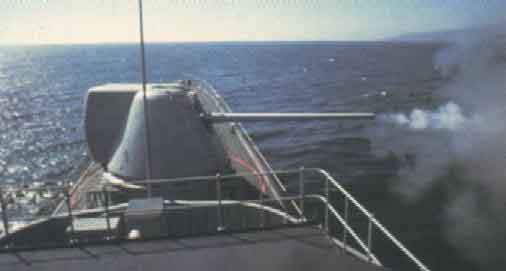
It was a single arrangement enclosed in the Mk 42 gun mount. The basic round for the MK
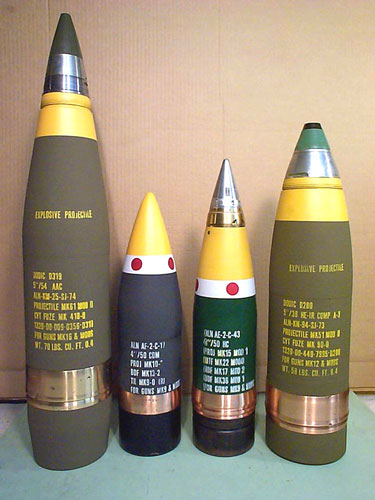
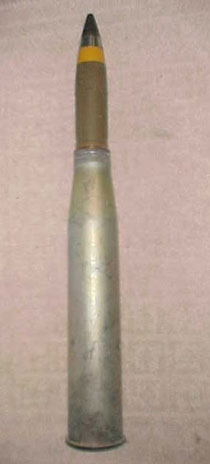
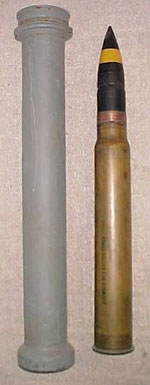
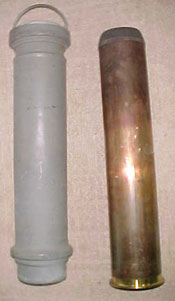
18 gun was semi-fixed, with a 70-pound projectile and a 34.5-pound shell case that
included a 19-pound powder charge. The initial velocity of the round was 2,650 feet/second
with a maximum range of 25,909 yards at 47 degrees elevation and a ceiling of 48,700 ft.
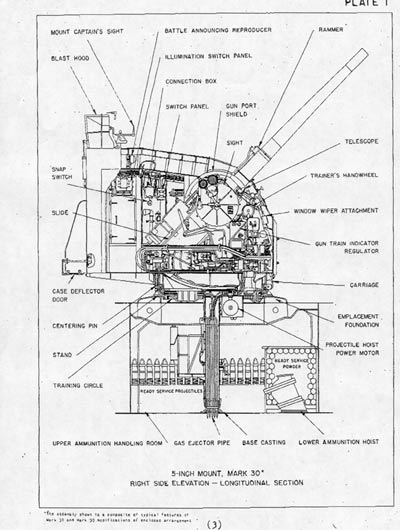
at 85 degrees elevation. The Mk 42 Gun Mount was the next generation of the Mk 39 mount
which was the original armament of the MIDWAY-Class carriers. The Mk 42 mount was a
shielded, base-ring-type mounting consisting of a gun house and carriage with rotating
structure, a fixed stand for mounting the base-ring, and the gun loading system.
The gun house was the armored portion of the rotating structure that contained the gun
and slide assembly, gun-laying equipment, and fire control equipment. The rotating
component transferred the rounds from the stationary gun loading components to the breech,
set MT fuzes, rammed the rounds, aimed the gun, fired the gun, extracted the empty powder
cases, and ejected the cases from the mount. The gun house rested on a heavy framework
supported by the base-ring assembly. The base-ring rotated on roller bearings within a
fixed stand that was bolted to the deck.
The loading system for the MK 42 mount consisted of two rotating loaders in the
handling room adjacent to the magazines, lower hoists, transfer stations, upper hoists,
cradles, and transfer trays. Each loader had two independently driven drums, the upper
drum for projectiles and the lower drum for powder cases. This arrangement allowed
different types of projectiles to be loaded. Each drum held twenty rounds and loading
doors on the drums five-inch guns. allowed ammunition handlers to continually replenish
the drums. The lower hoists raised the paired rounds, which remained together throughout
the loading operation, up to the transfer stations in the carrier room and transferred the
rounds to the ammunition carriers.
The ammunition carriers were mounted on the center column in the carrier room. The
tubes rotated around the center column until aligned with the upper hoists. After
transferring the rounds to the upper hoists the empty tubes rotated back into alignment
with the lower hoist transfer stations. The upper hoists, also mounted on the center
column, moved the rounds to the right and left cradles in the gun house.
The cradles pivoted on the slide trunions to convey the rounds to the right and left
transfer trays mounted on the gun slide. The fuze setters were also mounted on the slide
just forward of the trays. Fuze setting orders were received electrically from the gun
director or the plotting room and mechanically transmitted to the fuze on the projectile.
The trays held the rounds for fuze setting and then lowered the rounds to the ram
position. The round was then rammed and fired.
This dual loading system, which allowed rounds to be loaded alternatively from the
right and left sides of the gun, enabled a high rate of fire to be achieved. The gun was
touted as having a rate of fire of 40 rounds/minutte in dual sided operation. The mounts
could be rapidly trained at a rate of 40 degrees/second, elevated from -15 degrees to 85
degrees at 25 degrees/second, and loaded at any angle of elevation.