The 20mm Single Mark 4, Mark 10, and
Twin Mark 24
Gun Mounts

A left hand view of the ubiquitous single 20-mm Mark 4 gun mount
which was the U.S. Navy's standard light anti-aircraft machine gun
during World War II. The heavy cast pedestal housed an elevating
screw, which allowed the height of the gun to be adjusted.
By Robert F Sumrall (DD-762)
The light antiaircraft armament of nearly all U.S. destroyers during World War
11 was the 20-mm gun. An adaptation of the Swiss 20-mm Oerlikon it was produced
in single, twin, triple, and quadruple versions, however, only the single and
twin arrangements were made in production quantities. The original single Mark
4 mount began to replace the .50/cal. Browning Machine Gun with deliveries to
the fleet beginning in mid-1941. A light weight version, the Mark 10 was
introduced in 1943 and by late 1944 many destroyers returning to yards for
overhaul and the repair of battle damage were being fitted with the twin Mark
24 version. There is no indication in the records of the Bureau of Ordnance
that any triple or quadruple versions were ever fitted to destroyers.
The 20-mm gun assembly consisted of the machine gun mechanism, the gun barrel,
the sights, shoulder rests, and base-ring stand. The MK 4 used a heavy cast
steel, base-ring stand with a handwheel-operated screw jack to adjust its
trunion height. The MK 10 introduced a lightweight, welded-steel tripod
base-ring stand with a fixed trunion height. The MK 24 used the MK 10 stand and
an opposite-handed magazine for the left gun.
The gun mounts were free-swinging, hand-aimed, and required no external power
source. The gun was designed for automatic firing, using the energy of the
explosion to eject the empty cartridge case, cock, reload, and fire the next
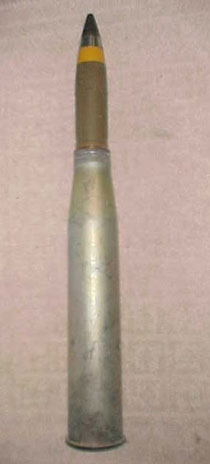
round. The 20mm cartridge weighed just over a quarter of a pound, and each
magazine contained 60 or 100 rounds. The gun was loaded by securing the
circular magazine to the top of the breech casing. The gun could fire 450
rounds/minute; however, this rate could never be achieved because of the
limited size of the magazines.
The original 20-mm gun mounts were equipped with open-ring sights for aiming,
relying on the operators' judgement to lead the target. Through a set of
handlebars and shoulder rests the operators' body movements controlled the
pointing and training of the guns. The operators had to lead the target in both
traverse and elevation. Usually, every fifth round in the ammunition belt was a
tracer that assisted the operators in spotting their fire. The sight consisted
of a forward open ring sight and a rear peep sight, either open or enclosed in
an eyepiece, attached to a sight bar which was bolted to the gun cradle.
Deliveries of a new lead-computing, relative rate gun sight, the MK 14, began
being delivered to the fleet in early 1943 and destroyers were fitted with the
sights during availability periods. The sight could be mounted on either of the
single or twin 20-mm mounts.
The 20-mm guns could throw up an impressive amount of fire for a ship the size
of a destroyer. They served as a deterrent against further action, such as
strafing after a plane had dropped its ordnance, but were truly a last-ditch
defense and did not deter the kamikaze pilots. As kamikaze tactics became more
commonplace, the 20-mm became less and less effective. It had to score enough
hits on a target to actually tear the plane to pieces before it crashed into
the ship. The development of the twin version of the 20-mm was intended to
further saturate the antiaircraft pattern but by the end of World War II the
20-mm was no longer an effective antiaircraft weapon. The 20-mm guns on
destroyers survived post-war for a time but were finally landed with the
armament conversion program of the early 1950s. There would be a resurgence of
the weapon, albeit in a somewhat different form, on destroyers during the 1970s
and 80s in the form of the six-barreled MK 15 Phalanx.