| The MK 108 Antisubmarine Rocket Launcher
By
Robert F. Sumrall
The standard World War II
antisubmarine warfare (ASW) battery installed in the U.S. Navy's
destroyer and destroyer escort forces changed little until the mid-1950s
when the first of the new Soviet submarines, spawned from the technology
of the German Type XXI U-boats, began to appear. As new ASW weaponry was
developed to address the Soviet submarine threat, numerous destroyers
and destroyer escorts were modified to carry the weapons. One of the new
weapons, the Mark 108 rocket launcher, was installed aboard the
destroyer leader Norfolk, a number of Fletcher- and Gearing-Class
destroyers, and several Dealey-Class destroyer escorts.
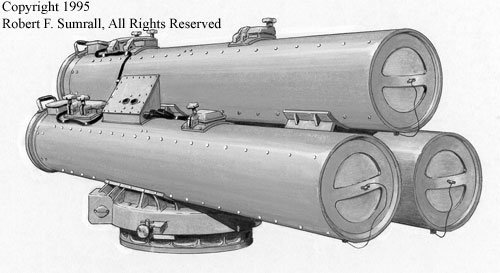
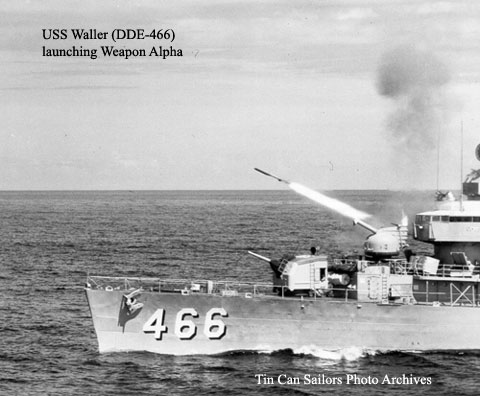
The Mark 108 launcher, often
referred to as "Weapon Able" or, later, "Weapon Alpha,"
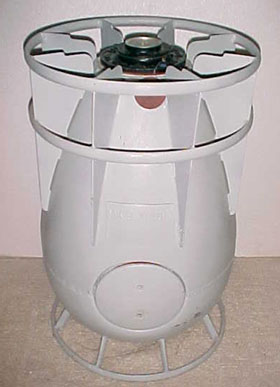
was a remotely controlled, automatically loaded rocket launcher for
firing the 12.75-inch Mark 1 and Mark 2 underwater rockets. Major units
included the mount, ready-service magazine with rocket hoist, lower
rocket hoist, and control equipment. |
| The mount included the rocket-launcher
guide, carriage, stand, shield, and power drives. The guide was a 12.75-inch
tube open at the breech end and muzzle and pivoted in the trunnion
bearings of the pedestal. The guide could be depressed 10 degrees and
elevated to its loading angle of 90 degrees. A circular blast deflector
was attached near the muzzle to deflect the rocket blast as the rocket
left the guide. The pedestal was mounted on a base-ring-type carriage that
supported the rotating assembly in the stand. The stand was a circular
assembly mounted to the deck, containing the roller bearing paths and the
training rack. The mount was provided with a circular shield for
protection against the weather and rocket blast that was not dissipated by
the muzzle deflector. A blast deflector was also fitted to the shield aft
of the breech to collect the gasses from the rocket ignition and vent them
directly upward over the shield. Power drives for training and elevating
the mount were located on each side of the pedestal within the shield.
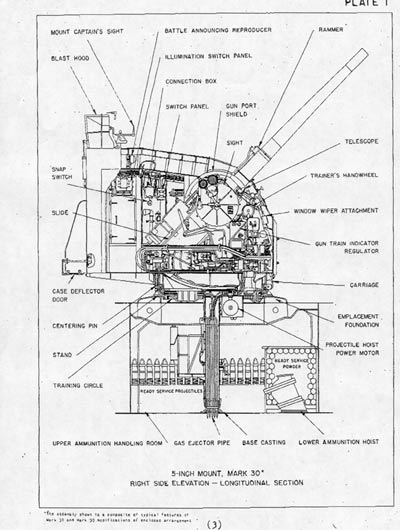
The ready-service magazine was
located directly below the mount stand and featured a vertical, rotating
rocket-handling ring, similar to the "merry-go-round"
arrangement of the 5-inch main-battery guns that held twenty-two
rockets. The handling ring was not concentric with the mount but offset
to intersect the center of the mount and align with the guide in its
vertical loading position. The rocket hoist was on the periphery of the
handling ring directly below the center of the mount and hoisted rockets
upward into the guide during loading.
The lower rocket hoist was in the
main magazine below the ready-service magazine. Positioned under the
periphery of the rocket-handling ring opposite the ready-service hoist
above, it hoisted rockets upward into the ring.
The controls and associated
equipment were located and operated within the bulkheads of the ready-service
magazine compartment. The launcher could fire either the Mark 1 or Mark
2 rockets at a rate of 12 rounds per minute. For ASW training exercises,
the Mark 19 rocket launcher could be inserted in the guide if the Mark
15 launcher to fire the 4-inch, subcaliber Mark 2 Rocket. |