| The Anti-Submarine Rocket (ASROC) |
| By Robert F. Sumrall (DD-762) |
|
| The threat posed by high-speed,
high-endurance Soviet submarines was of grave concern to U.S. military
planners in the 1950s. No longer was it likely a destroyer could get close
enough to drop depth charges directly over a submarine. "Stand
off" weapons would be needed to attack at a considerable distance.
ASROC had a 10,000-yard range, about the same as the new SQS-23 sonar.
Together they made a potent combination. |
|
| The ASROC Weapons System was first installed
in the USS NORFOLK (DL-1) followed by these classes:
CHARLES F. ADAMS (DDG-2)
FARRAGUT (DLG-6)
SPRUANCE (DD-963)
GEARING (DD-710) FRAM I
FORREST SHERMAN (DD-931) ASW modifications
LONG BEACH (CGN-9)
And several classes of Destroyer Escorts. |
|
| The MK 112 box-like, eight-barrel launcher
was the visible part of the group that, to everyone, was commonly known as
the "ASROC." It served as a ready service magazine for eight
ASROC missiles and positioned them for firing. The launcher was divided
into four double guides, each housing two missiles in an over-under
arrangement. It was similar to a gun mount in that it had a stand, or
carriage, secured to the deck. One guide was elevated at a time. The
missiles were fired at a constant launching angle of 45 degrees from the
horizontal. The launcher was stabilized so a constant launching angle
could be maintained in a rolling, pitching sea. |
|
| The cells were temperature controlled
because extreme conditions could cause the missiles to malfunction and
overheat, igniting the rocket motors. Each cell had a solid door forward
and a soft closure aft. The closure aft was blown out by the missile blast
during firing and was replaced when the cell was reloaded. Each cell had a
restraining latch and snubber mechanism that prevented any movement of the
missile until released for firing. Just prior to firing, the door was
opened and the guide rail was extended to the proper length to direct the
missile out of its cell and into the correct path of flight. |
|
| The control station for firing the missiles
was a blast proof enclosure located near the launcher. It housed the
Launcher Captain’s Control Panel. The panel enabled the launcher captain
to train and elevate the launcher, select a rail and missile, extend a
rail and open its door, clear selections, fire the missile, and immobilize
the launcher. |
|
| The Launcher and Missile Simulator was also
located in the ASROC launcher control station. The simulator provided
training for operating personnel without moving the launcher or closing a
firing circuit and thus eliminated any chance of an accidental missile
firing. |
|
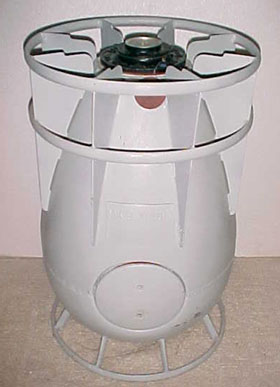
| The ASROC missile was a solid-fuel,
rocket-propelled, ballistic missile, which could be assembled with a
payload of either an antisubmarine acoustic-homing torpedo or a nuclear
depth charge. Each missile was about 15 feet long had four component
sections: the payload, rocket motor, airframe, and ignition and separation
assembly. |
|
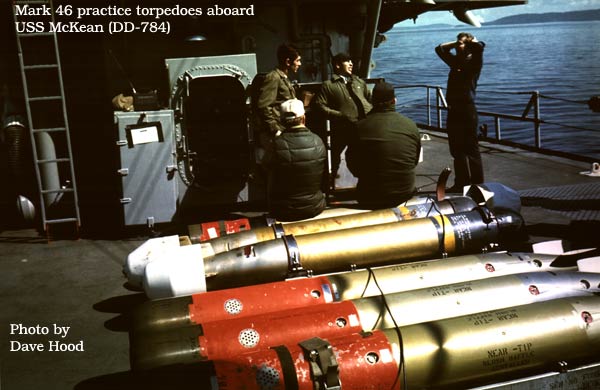
| The torpedo arrangement used either the Mk
44 or Mk 46 torpedo while the depth charge arrangement delivered the W 44
nuclear warhead. Both versions were fitted with special nose caps to
improve the aerodynamic flight of the missile and protect the nose of the
torpedo or depth charge when entering the water. The torpedo used a
parachute for the last part of its flight while the depth charge was
fitted with folding fins for stabilization in the final portion of its
trajectory. |
|
| The missile flight sequence was the same for
either the torpedo or depth charge until the final stage of the flight.
When the missile reached the predetermined velocity required to propel the
payload in its ballistic trajectory to the intended point of entry in the
water, an explosive block in the ignition and separation assembly was
electrically detonated and the rocket motor was discarded. At another
predetermined point, near the height of the trajectory, another explosive
block separated the payload from the airframe. |
|
| In the torpedo-carrying arrangement, the
parachute was activated and the torpedo was armed when the airframe was
discarded. The parachute slowed the descent of the torpedo to a safe water
entry velocity. The nose cap was shattered and the parachute discarded
upon impact, which allowed the torpedo to begin its search pattern. |
|
| When the nuclear depth charge payload
separated from the airframe section, it continued on its trajectory to the
intended water entry point. Its nose cap also shattered on impact and the
stabilizing fins were discarded. The depth charge, having been armed
before launching, sank and was detonated at a preset depth. |
|
| The nuclear depth charge version of ASROC
was tested only once. On 11 May 1962, about 370 miles off San Diego, the
USS AGERHOLM (DD-826) fired an ASROC as the "Swordfish" shot of
the Operation Dominic I series of nuclear weapons tests. AGERHOLM launched
the missile at a target raft some 4,000 yards away. The resulting blast
was approximately as powerful as the one that destroyed Hiroshima. |
|
| Among the ships participating in the
Swordfish shot were RICHARD B. ANDERSON (DD-786), HOPEWELL (DD-681),
BAUSELL (DD-845), MADDOX (DD-731), BRUSH (DD-745), PRESTON (DD-795), and
SAMUEL N. MOORE (DD-747). |
|
| Copyright 2000 Tin Can Sailors. All rights reserved. |