|

The 21-in Quintuple MK 14 and MK 15 Torpedo
Tubes
By Robert F. Sumrall (DD 762)
From their inception, destroyers have always
carried a heavy torpedo battery for their size and tonnage. The 21-inch torpedo was
introduced in the O'BRIEN(DD-51) class of 1912, one of the immediate predecessor classes
of the flush-deck four-stackers which began with the CALDWELL (DD 69)class of 1915.
Torpedoes were fired from twin tube mounts in the O'BRIEN-class and from triple tube
mounts in the CALDWELL-class. The FARRAGUT (DD-348) class of 1933, the first of the new
destroyers, was equipped with quadruple tube mounts which remained standard until the
BENSON (DD-421)/GLEAVES (DD-423)classes of 1937 when the quintuple tube mounts were
introduced. They then became the standard and were also used on the FLETCHER (DD-445)
class, ALLEN M. SUMNER (DD-692) class, and GEARING (DD-710) class.
Since the 1950s, the torpedo, as launched from surface vessels, has
evolved primarily into an ASW weapon. The varied sizes and shapes of the new torpedoes
required different delivery systems and devices, which eventually replaced all of the
original tube mounts.
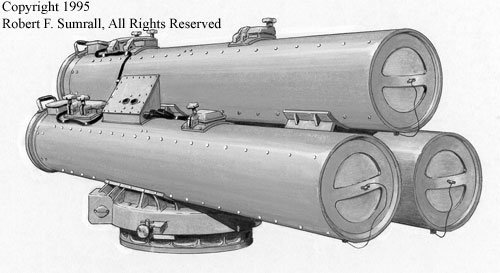
The MK 14 and MK 15 torpedo tube mounts were designed for launching
the 21-inch MK 15 torpedo. The tubes were mounted in a trainable, quintuple arrangement
that included the following major components: the stand, saddle, barrels, controls,
heating equipment, and a blast shield (MK 15 only). Except for the shield, which was
installed to protect the operating crew from nearby 5-inch gun blast, the MK 14 and MK 15
mounts were identical. The stand and saddle were the equivalent of a base ring and
carriage in a gun mount. The stand was bolted to the deck and housed the training circle
and bearings for the saddle.
The saddle supported the five barrels in a parallel arrangement and
was secured to the stand with hold down clips. The barrel assemblies, consisting of the
main barrel, door, and spoon extension, were bolted to the saddle through two mounting
ring flanges. The doors were on the aft or breech end of the barrel and hinged to avoid
interference with each other. The spoon extensions on the forward end of the barrels were
hinged and could be folded backwards on top of the barrel providing access to the torpedo
warhead. The controls for setting the torpedo gyro, depth, and speed were fitted atop the
barrels just aft of the mounting ring flanges. The settings were made electrically. Two
rows of barrel heaters were fitted to the underside of the barrels at the controls in the
area of the torpedo mechanisms.
A firing mechanism was fitted to the top of each tube at the aft end
just forward of the breech doors. Torpedoes were launched individually by the ignition of
a charge of black powder from an impulse cartridge inserted into the firing mechanism. The
cartridge could be fired by manual or hydraulic percussion or electrically. The operating
mechanism of the torpedo was started mechanically by a tripping latch when the torpedo
left the muzzle of the barrel.
Torpedoes were loaded through the doors at the breech end of the
tubes. A retractable loading crane and chain fall held the torpedo while alignment and
orientation with the tube was established. The torpedo was then manually pushed into the
tube.
The MK 15 torpedo was 21-inches in diameter, 24
feet long, and weighed
3,850 pounds.
|